Strength Tarot Meaning for Manifestation: Inner Power & Courage
 Enid Rosa
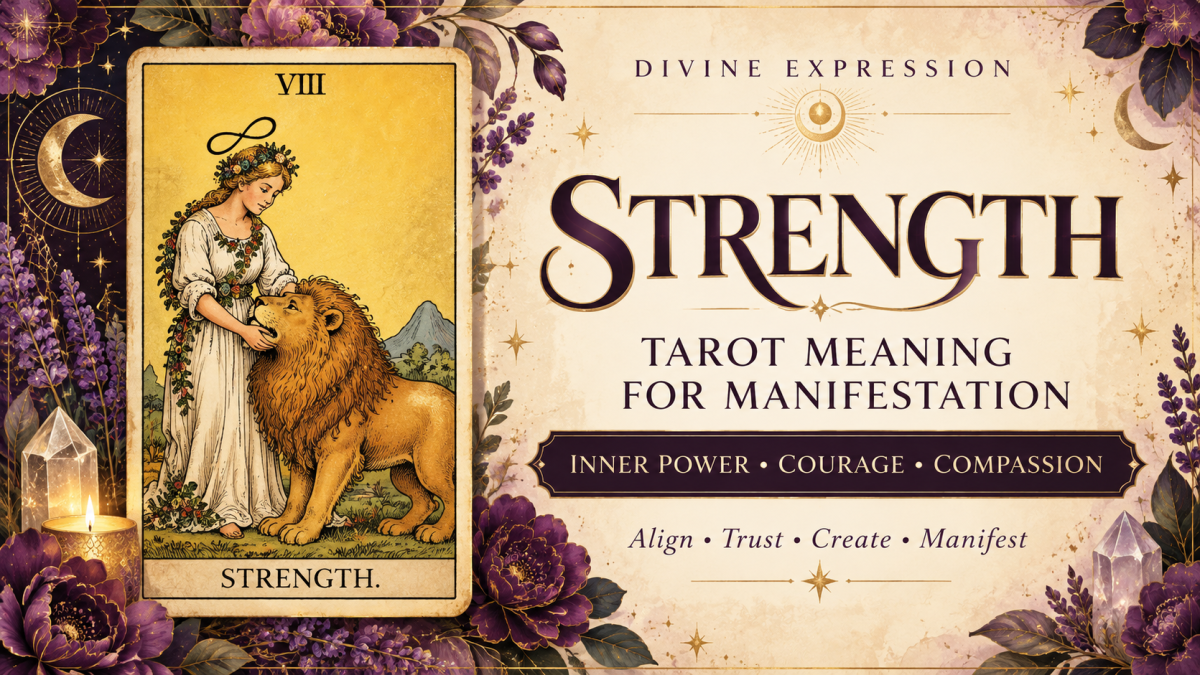
Discover Strength tarot meaning for manifestation and explore inner power, courage, compassion, self-trust, emotional mastery, and conscious embodimen
Manifestation is often described as becoming more confident, taking action, overcoming fear, and stepping into your power.
But Strength introduces a more nuanced understanding of what personal power actually looks like.
Strength does not ask you to become fearless.
It does not ask you to suppress uncomfortable emotions, push through every limitation, or force yourself into becoming someone new.
Instead, Strength teaches compassionate self-mastery.
In the traditional imagery of the card, a woman stands calmly with a lion. She does not fight the lion or attempt to destroy its wildness. She develops a relationship with it.
For manifestation, this becomes a powerful metaphor.
The lion can represent your fears, desires, instincts, anger, vulnerability, emotional intensity, and all the powerful parts of yourself that may become activated as you grow.
Strength asks:
Can you meet those parts of yourself with compassion while still consciously choosing how you move forward?
Because your power is not found in defeating yourself.
It is found in learning how to lead yourself.
What Does Strength Mean in Tarot?
Strength is traditionally associated with courage, inner strength, patience, compassion, confidence, resilience, and self-control.
But Strength is not simply about being tough.
The power represented by this card is quieter.
It is the ability to remain connected to yourself when something difficult arises.
Strength can look like:
- experiencing fear without automatically retreating
- feeling anger without immediately reacting
- acknowledging vulnerability without interpreting it as weakness
- remaining patient when something is taking longer than expected
- trusting yourself even when you cannot control the outcome
- responding consciously instead of reacting impulsively
- allowing yourself to receive support rather than carrying everything alone
Strength reminds us that real power does not always need to announce itself.
Sometimes the most powerful thing you can do is remain present.
Strength as a Manifestation Archetype
Within Tarot Manifestation, I call Strength:
The Compassionate Sovereign
The Compassionate Sovereign possesses power without needing to prove it.
She does not need to overpower herself or anyone else to know that she is powerful.
She can acknowledge fear without surrendering her choices to it.
She can experience anger without becoming consumed by it.
She can honor vulnerability without believing she has become weak.
She can listen to instinct without allowing impulse to make every decision.
Her strength comes from the relationship she has developed with herself.
Her manifestation code is:
EMBODY
Because Strength reminds us that manifestation isn't simply about wanting something.
Eventually, you are asked to embody the qualities that support the life you're creating.
Courage.
Compassion.
Patience.
Self-trust.
Emotional steadiness.
Confidence.
Resilience.
These aren't qualities you wait to receive after your manifestation arrives.
They become part of who you are while you're creating it.
The Symbolism of Strength
The imagery within Strength reveals much of its manifestation teaching.
The Woman
The woman represents conscious awareness, compassion, calm confidence, and the ability to work with powerful internal experiences without being overtaken by them.
Her power is not aggressive.
She doesn't need to prove that she is stronger than the lion.
She simply knows how to remain present with it.
For manifestation, she represents the part of you capable of consciously leading yourself.
The Lion
The lion represents instinctive power.
It can symbolize:
- fear
- anger
- passion
- desire
- impulse
- emotional intensity
- vulnerability
- primal instinct
- creative life force
These parts of ourselves aren't inherently negative.
They contain enormous energy.
The question is whether we suppress them, become controlled by them, or develop a conscious relationship with them.
The Woman and Lion Together
This relationship is one of the most important symbols within Strength.
The goal isn't to destroy the lion.
The goal is integration.
This is why Strength can become such a powerful manifestation archetype.
You don't have to eliminate every fear, insecurity, or emotional response before you are allowed to move toward what you desire.
You learn how to bring those parts of yourself with you without allowing them to control the entire journey.
The Infinity Symbol
The infinity symbol above the woman's head represents higher consciousness and limitless spiritual power.
It reminds us that Strength is not merely physical.
This is inner mastery.
The White Dress
The white dress can symbolize purity of intention and spiritual consciousness.
Her strength isn't rooted in domination.
It is guided by awareness.
The Floral Garland
The flowers reinforce one of the central paradoxes of Strength:
Gentleness and power can exist together.
You do not have to become harder in order to become stronger.
The Mountains
The mountains can represent challenge, growth, endurance, and the wisdom developed through experience.
Strength is not theoretical.
Often, we discover our strength because life gives us opportunities to practice it.
The Gift of Strength
The Gift of Strength is inner power guided by compassion.
In its Gift expression, Strength can represent:
- courage
- compassion
- patience
- emotional steadiness
- self-trust
- quiet confidence
- resilience
- healthy vulnerability
- emotional awareness
- conscious response
- gentle influence
- healthy relationship with instinct
- confidence without domination
- strength without force
One of the most important teachings of this archetype is:
You can feel something without becoming controlled by it.
You can say:
“This is what I'm feeling, and I still get to choose how I respond.”
That is emotional strength.
Strength and Courage
Courage is sometimes mistaken for fearlessness.
But Strength gives us a different definition.
Courage can mean:
“I'm afraid, and I'm willing to take the next aligned step anyway.”
Imagine you want to become more visible.
You know you need to share your ideas, speak publicly, launch something, post your work, or allow yourself to be seen.
And fear appears.
The Shadow response might be:
“Why am I still afraid? I should be over this.”
Strength responds differently:
“Of course part of me feels vulnerable. I'm doing something that matters to me. What would help me feel supported enough to take the next step?”
You don't have to wait for fear to disappear.
Fear and courage can exist at the same time.
Strength and Self-Trust
Strength also teaches a deeper form of self-trust.
Sometimes we think confidence comes from knowing everything will work out exactly as planned.
But that's fragile confidence because it depends on circumstances.
Strength develops another kind:
“Whatever happens, I trust myself to meet it.”
Now your confidence isn't entirely dependent on knowing the future.
It comes from your relationship with yourself.
You know you can adjust.
You can ask for help.
You can change direction.
You can recover.
You can rest.
You can try again.
You can make another decision.
This creates a powerful foundation for manifestation because uncertainty no longer automatically means powerlessness.
The Shadow of Strength
Every archetype has a Gift and a Shadow.
The Shadow of Strength can emerge through suppression, domination, self-judgment, overfunctioning, or the belief that you always have to be strong.
It might sound like:
“I shouldn't feel this.”
“I should be able to handle this.”
“I don't need help.”
“I can't let anyone see me struggle.”
“I just need to push through.”
Instead of developing a relationship with the lion, we try to put the lion in a cage.
When Being Strong Becomes a Burden
One of the most subtle expressions of the Strength Shadow is performing strength.
You become the person who can handle everything.
Everyone depends on you.
You keep going.
You solve the problems.
You rarely ask for help.
You tell yourself:
“I've got it.”
From the outside, this can look strong.
Internally, you may be exhausted.
Resentful.
Overwhelmed.
Disconnected from your own needs.
Or afraid that everything will fall apart if you stop holding it together.
There is a difference between genuine inner strength and survival-based overfunctioning.
Strength asks you to notice that difference.
Being powerful does not mean you are never allowed to need support.
When Strength Becomes Suppression
Strength can also become distorted when we begin judging ourselves for normal human emotions.
Maybe you're afraid and immediately tell yourself you shouldn't be.
Maybe you're angry but have learned that anger is unacceptable.
Maybe you're grieving but believe you should have moved on already.
Maybe an old insecurity resurfaces and you think:
“I thought I healed this.”
Growth isn't always linear.
Something resurfacing doesn't automatically mean you've failed.
Sometimes you're simply meeting the same pattern with a new level of awareness.
Instead of asking:
“Why am I still like this?”
Strength invites you to ask:
“How can I meet this version of myself differently?”
Strength and the Need for Control
The Shadow can also appear through domination and control.
When vulnerability feels unsafe, we may try to control ourselves, other people, circumstances, or outcomes.
We may believe power means having the upper hand.
But genuine Strength does not need to overpower.
It is grounded enough to respond consciously.
This is especially important in manifestation.
There is a difference between consciously participating in your life and believing you must control every detail of how your desire arrives.
Strength reminds you:
Your power does not require force.
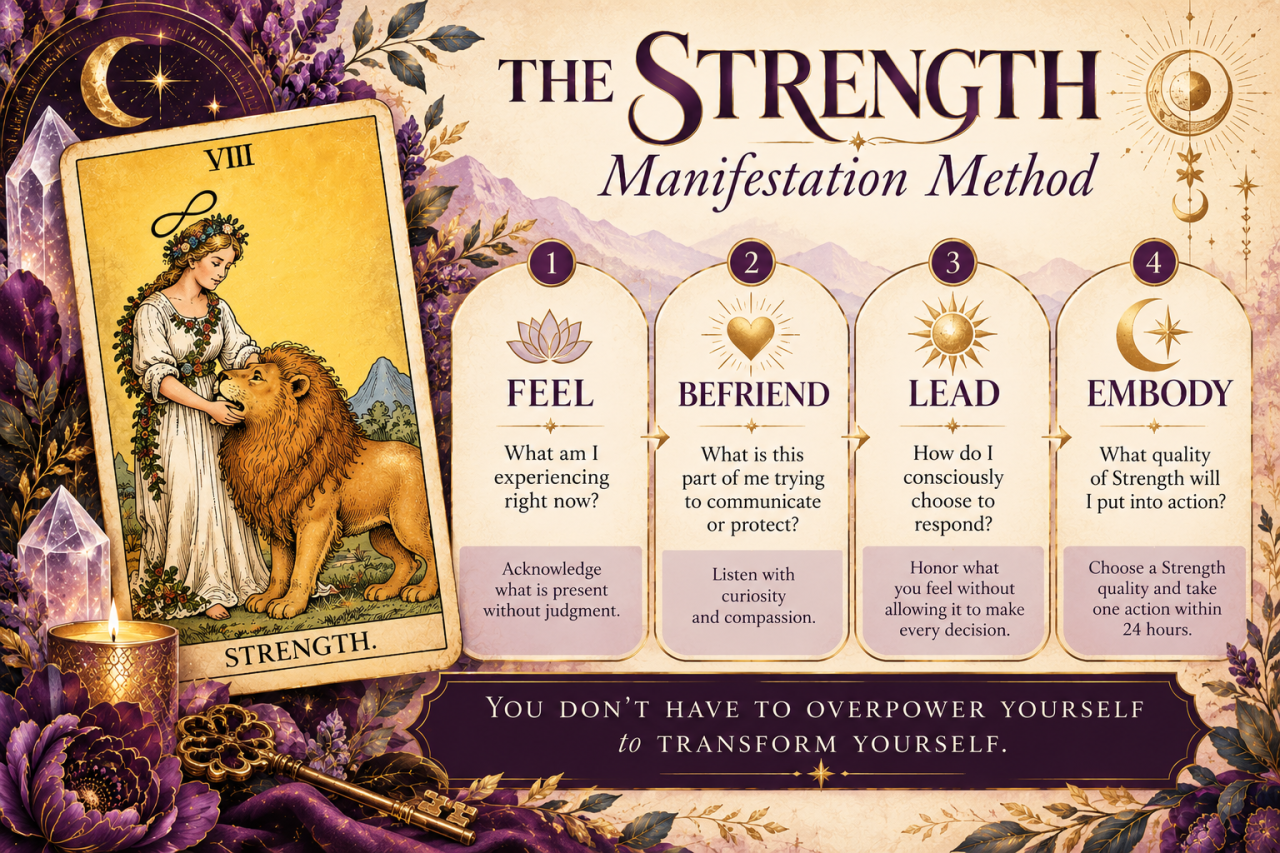
The Manifestation Lesson of Strength
The manifestation lesson of Strength is:
Feel → Befriend → Lead → Embody
This gives you a practical way to work with whatever surfaces while you're creating something new.
1. Feel
Acknowledge what is actually present.
Ask:
“What am I feeling right now?”
Fear?
Anger?
Uncertainty?
Resistance?
Impatience?
Vulnerability?
Don't immediately try to fix it.
Notice it.
2. Befriend
Now become curious.
Ask:
“What is this part of me trying to communicate or protect?”
Fear might be protecting you from rejection.
Perfectionism might be protecting you from criticism.
Control might be protecting you from uncertainty.
Overworking might be protecting you from the fear that you're not doing enough.
Understanding the pattern doesn't mean you have to continue it.
It simply allows you to respond from compassion instead of self-judgment.
3. Lead
Now ask:
“How do I consciously choose to respond?”
This is where compassion meets self-leadership.
You can listen to fear without allowing fear to make every decision.
You can acknowledge anger without immediately reacting.
You can recognize the urge to control without trying to control everything.
You listen—and then you lead.
4. Embody
Finally ask:
“What quality of Strength am I being invited to embody?”
Maybe it's:
Courage.
Patience.
Compassion.
Self-trust.
Confidence.
Vulnerability.
Emotional steadiness.
Then turn that quality into an action.
Because embodiment is where the archetype becomes lived experience.
How to Embody Strength
Choose one situation in your life where you currently feel challenged, activated, or vulnerable.
Then identify your inner lion.
Ask:
“What part of me becomes activated when I move toward what I want?”
Maybe it's fear.
Self-doubt.
Perfectionism.
Anger.
Impatience.
Control.
The desire to retreat.
The belief that you need to prove yourself.
Once you've identified it, move through the Strength practice:
Feel: What am I experiencing?
Befriend: What is this part trying to communicate or protect?
Lead: How do I consciously choose to respond?
Embody: What quality of Strength will I put into action?
Then choose one action you can take within the next 24 hours.
At the end of the day ask:
“Did I overpower myself today—or did I lead myself?”
If you notice that you slipped into judgment, suppression, or force, don't turn that realization into another reason to criticize yourself.
Notice.
Meet.
Redirect.
Begin again.
That's part of the practice too.
Strength Tarot Affirmations
Use these affirmations while working with the Strength archetype:
- I trust the quiet strength and power that already lives within me.
- I can feel fear and still choose courage.
- I meet myself with compassion instead of judgment.
- I honor what I feel while consciously choosing how I respond.
- I trust myself to meet uncertainty with courage, patience, and grace.
- My power does not require force. I lead myself with strength and compassion.
- I embrace my inner lion and channel its power with conscious intention.
Strength Journal Prompts
Use these prompts for deeper reflection:
- Where am I stronger than I currently give myself credit for?
- What part of me am I trying to control that actually needs compassion?
- Where is fear present in my life, and what would courage look like here?
- Where am I trying to force, push, or control something that needs patience and inner strength?
- What emotion am I being invited to listen to without allowing it to lead every decision?
- Where have I been trying to appear strong when what I really need is support?
- What quality of Strength am I being asked to embody right now, and what would it look like in action?
Strength Tarot Manifestation Spread
Use this five-card spread when you want to understand what Strength is asking you to embody.
Card 1 — The Inner Lion
What emotion, fear, instinct, or part of myself is asking for my attention?
Card 2 — The Message
What is this part of me trying to communicate or protect?
Card 3 — The Compassion
How can I meet this part of myself with greater understanding and compassion?
Card 4 — The Strength
What quality of inner strength am I being invited to embody?
Card 5 — The Embodiment
What action will allow me to express this Strength in my life?
After pulling the cards, choose one practical action inspired by Card 5.
Don't stop at insight.
Become the archetype.
When to Work With Strength
Work with Strength when you are:
- facing something that requires courage
- afraid of being seen
- moving through self-doubt
- struggling with emotional intensity
- becoming impatient with yourself
- trying to force an outcome
- learning to trust yourself
- navigating vulnerability
- setting or maintaining boundaries
- judging yourself for what you feel
- pushing through exhaustion
- afraid to ask for support
- stepping into a larger expression of yourself
Strength can be especially supportive when you know what you want but discover that becoming the person capable of holding it is bringing something deeper to the surface.
From The Chariot to Strength: Direction Becomes Inner Mastery
The progression from The Chariot to Strength is important within the Major Arcana journey.
The Chariot asks:
“Where are you going?”
It teaches:
Choose → Focus → Move → Direct
You take the reins and begin consciously directing your energy.
Then Strength asks:
“Who are you becoming as you travel there?”
It teaches:
Feel → Befriend → Lead → Embody
Because once you begin moving, things arise.
Fear.
Resistance.
Uncertainty.
Vulnerability.
Old patterns.
Powerful desires.
The Chariot teaches you how to direct your movement.
Strength teaches you how to lead yourself through what arises because you're moving.
Together they remind us that self-leadership requires both direction and compassion.
Final Reflection
Strength changes the question from:
“How do I get rid of the part of myself that's afraid?”
to:
“How do I lead myself compassionately while fear is present?”
You don't have to become harder to become more powerful.
You don't have to suppress vulnerability to become courageous.
You don't have to control every emotion to practice self-mastery.
And you don't have to defeat your inner lion before you're allowed to move toward the life you desire.
Meet it.
Listen to it.
Lead it.
Walk beside it.
Because sometimes the greatest expression of strength is realizing:
I can hold what I feel without abandoning who I am becoming.
Align. Trust. Create. Manifest.
— Divine Expression
Recommended Reading
At the bottom of the article, link to:
Categories: : Tarot