How to Use Tarot for Shadow Work: A Beginner-Friendly Guide to Inner Healing
 Enid Rosa
Learn how to use tarot for shadow work with simple spreads, intuitive reflection, and journaling practices that reveal hidden patterns within you.
Using Tarot for Shadow Work
Tarot can be so much more than a tool for asking what comes next.
It can become a mirror for what is already happening within you.
The cards can illuminate patterns, beliefs, emotional triggers, desires, and blind spots that may be difficult to recognize through ordinary reflection alone. That is what makes tarot for shadow work such a powerful practice.
And you do not need years of tarot experience to begin.
You simply need a deck, curiosity, and a willingness to sit with what the cards bring forward.
Instead of asking:
“What is going to happen?”
Shadow work tarot asks:
“What am I being invited to see?”
That small shift can transform the way you work with the cards.
Why Tarot Works for Shadow Work
Tarot speaks through symbols, archetypes, colors, imagery, and stories.
Sometimes a direct question such as Why do I keep sabotaging myself? immediately activates the analytical mind. We reach for the explanation we already know.
Tarot interrupts that familiar pattern.
You might pull The Tower, The Devil, The Hermit, or another card that causes you to look at the question differently.
Suddenly, you have an image in front of you.
You can notice your reaction to it.
You can explore what the symbolism reminds you of.
You can ask what part of your own story is being reflected through the card.
The original article describes tarot as a way of externalizing internal material and creating structure around introspection. Rather than trying to examine your entire inner world at once, the cards give you something specific to explore.
This is one reason tarot pairs so beautifully with shadow work.
The card becomes the mirror. Your response becomes part of the message.
If you're completely new to this inner work, begin with What Is Shadow Work (And What It Isn't) before exploring the cards.
What You Need to Start Tarot Shadow Work
You really only need one thing:
A tarot deck.
Choose a deck whose imagery speaks to you.
Traditional Rider-Waite-Smith imagery can be helpful because so many tarot resources reference its symbolism, but you do not have to begin there.
What matters for shadow work is your ability to connect with the imagery.
Learn the traditional meanings, but don't become so attached to them that you ignore your own response.
For example, The High Priestess may traditionally evoke intuition, mystery, inner knowing, and what remains hidden.
But perhaps you look at her and immediately think about your relationship with your mother.
Pay attention to that.
Your association may be part of the shadow-work doorway.
The original article makes this distinction especially well: traditional interpretations can provide a foundation, but shadow work also asks you to notice what the card personally brings forward for you.
Basic Tarot Spreads for Shadow Work
You don't need an elaborate Celtic Cross to explore your shadow.
In fact, starting with fewer cards can help you stay focused.
One-Card Shadow Work Check-In
Pull one card and ask:
What do I need to see about myself today?
Before reaching for your guidebook, look at the card.
What is your immediate reaction?
What catches your attention first?
How does the image make you feel?
What does it remind you of?
Then journal about what comes forward.
A one-card pull is especially helpful when you're beginning because it allows you to explore one theme without becoming overwhelmed.
Three-Card Shadow Work Spread
When you're ready to go deeper, try:
Card 1 — Root:
What is underneath this pattern?
Card 2 — Expression:
How is this pattern showing up in my life now?
Card 3 — Integration:
What am I being invited to understand, reclaim, or change?
Three cards provide enough information to reveal a story while still keeping the reading manageable.
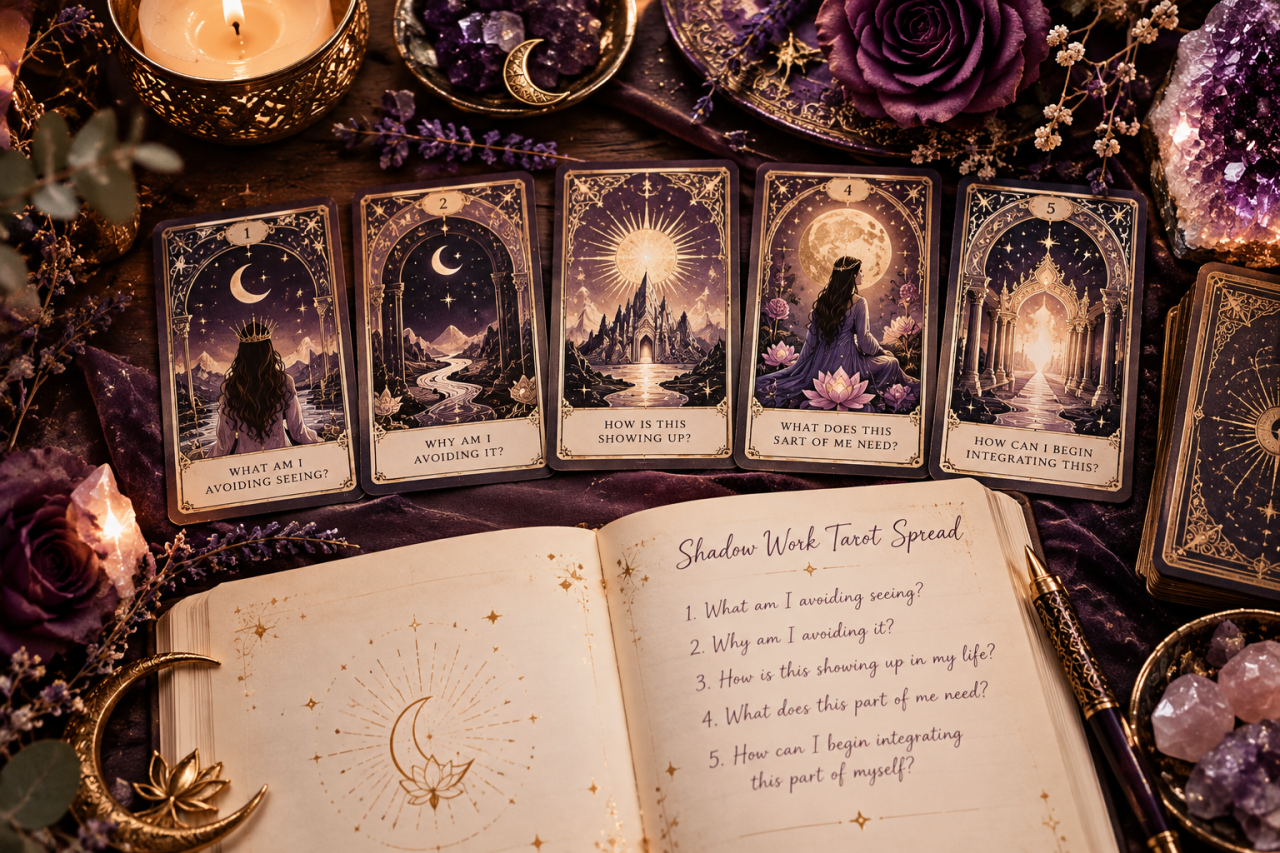
Five-Card Shadow Self Tarot Spread
When you feel ready for deeper reflection, try this spread:
Card 1: What am I avoiding seeing?
Card 2: Why am I avoiding it?
Card 3: How is this avoidance showing up in my life?
Card 4: What does this part of me need?
Card 5: How can I begin integrating this part of myself?
This spread moves beyond simply identifying the shadow.
It invites you to understand why the pattern exists and what the hidden part of you may actually need.
That is an important distinction.
Shadow work isn't about hunting down everything you dislike about yourself.
It's about bringing awareness, compassion, and choice to what has been operating outside your conscious awareness.
The Four-Card Mirror Spread
Projection can be one of the clearest ways our shadow becomes visible.
Try asking:
Card 1: What trait am I strongly judging in someone else?
Card 2: Where have I rejected or suppressed this quality within myself?
Card 3: How might this quality serve or protect me?
Card 4: What would healthy integration of this quality look like?
This does not mean that every behavior you dislike in another person secretly describes you.
Instead, the spread invites you to become curious when a reaction feels especially charged.
You can explore this concept more deeply in How Emotional Triggers Reveal Your Shadow.
How to Read Tarot Cards for Shadow Work
Reading tarot for shadow work requires a slightly different approach from asking the cards for predictions.
Instead of beginning with:
What does this card mean?
Begin with:
What does this card stir within me?
Notice Your First Reaction
Before looking up the traditional interpretation, pause.
Do you feel:
- uncomfortable?
- relieved?
- defensive?
- curious?
- irritated?
- confused?
Your reaction is information.
Explore the Imagery
Look closely at the card.
What symbol catches your attention?
What is happening in the background?
Where is the person looking?
Does the card feel expansive or restrictive?
What story immediately comes to mind?
Allow yourself to free-associate before reaching for the guidebook.
Add the Traditional Meaning
Now bring in what you know about the card.
Let traditional tarot symbolism deepen the reflection rather than dictate it.
Ask Follow-Up Questions
If something feels unclear, you can pull a clarification card.
The goal isn't to replace an uncomfortable card.
It's to understand it more deeply.
Journal the Reading
Write down:
- your question
- the cards you pulled
- your immediate reactions
- interpretations
- emotions that surfaced
- patterns you noticed
- any action or integration that feels appropriate
This is where tarot and shadow work journaling become especially powerful together.
You may want to pair this practice with Shadow Work Journaling: The Easiest Way to Start.
Tarot Cards That May Appear During Shadow Work
Certain tarot archetypes naturally lend themselves to shadow exploration.
The Moon can invite reflection around uncertainty, fear, intuition, or something you aren't seeing clearly.
The Devil may bring attention to attachment, restriction, unhealthy patterns, or places where you feel powerless.
The Tower can illuminate structures, identities, or beliefs that are being challenged.
The Hanged Man can invite surrender or a different perspective.
Five of Cups may bring grief, disappointment, or fixation on what has been lost into awareness.
Seven of Swords may invite questions about avoidance, strategy, honesty, or self-deception.
Eight of Swords can illuminate restrictive beliefs and places where your own thinking contributes to feeling trapped.
The Hermit may invite solitude, introspection, or deeper inner listening.
These aren't fixed shadow meanings.
The context of your question, the surrounding cards, and your own relationship with the imagery all matter. The original article similarly presents these interpretations as starting points rather than absolute definitions.
What If a Tarot Card Doesn't Make Sense?
Don't immediately discard it.
Pause.
Sometimes the card that makes you think, That has nothing to do with my question, creates the most interesting reflection.
Ask:
Why am I resisting this card?
What was I hoping to receive instead?
What about this image makes me uncomfortable?
Is there another way I could interpret it?
If you genuinely need more information, pull a clarification card rather than repeatedly drawing until you receive a card you prefer.
Shadow work requires a willingness to sit with uncertainty.
Create a Safe Container Before Going Deeper
Tarot can uncover emotionally charged material, so your practice should have boundaries.
Before beginning a deeper spread, decide how much time you're giving the reading.
Have your journal nearby.
Ground yourself before you begin.
And give yourself permission to stop.
You don't need to interpret every card immediately or resolve every issue during one reading.
For a fuller practice, read How to Create a Safe Container for Shadow Work before working with deeper spreads.
Making Tarot Shadow Work a Regular Practice
Consistency is more valuable than intensity.
You could begin with a simple rhythm:
Daily: One-card reflection.
Weekly: One three-card shadow work spread.
Monthly: A deeper five-card Shadow Self or Mirror Spread.
Keep a tarot journal and record your readings.
Over several weeks or months, look back.
Which cards repeat?
Which emotional themes continue appearing?
Which questions have changed?
Which patterns no longer feel as charged?
Your journal allows you to witness your own evolution.
The original article recommends using tarot consistently rather than only reaching for it during crisis, as well as recording readings so recurring patterns become easier to recognize over time.
Divine Expression Resources for Your Shadow Work Journey
If you want to deepen the work beyond a single tarot reading, explore these Divine Expression resources:
Shadow Work Guidebook
Use guided reflection to recognize hidden patterns, emotional triggers, and aspects of yourself ready for greater awareness and integration.
If something deeper surfaces and you want personalized spiritual support, you can explore working with me privately.
Start With One Card
You do not need to master tarot before you can use it for self-reflection.
Start with one card.
Ask:
What am I not seeing about myself right now?
Look at the image before reaching for the guidebook.
Notice what you feel.
Notice what you resist.
Then write.
The purpose isn't to force an answer from the cards.
It is to create enough space for your own truth to become visible.
Related Shadow Work Articles
- What Is Shadow Work (And What It Isn't)
- How Emotional Triggers Reveal Your Shadow
- Shadow Work Journaling: The Easiest Way to Start
- How to Create a Safe Container for Shadow Work
- 10 Gentle Shadow Work Journal Prompts
Shadow Work Disclaimer
The content on this site is for informational and educational purposes only. It is not intended as a substitute for professional mental health care, therapy, or medical advice. If you're experiencing mental health challenges, trauma, or crisis, please seek support from a licensed mental health professional.
Categories: : Tarot