7 Ways to Protect Your Energy and Maintain Your Spiritual Peace
 Enid Rosa
Learn 7 spiritual ways to protect your energy, set healthy boundaries, stay grounded, and maintain your peace around draining people and situations.
Have you ever walked away from a conversation feeling completely drained?
Maybe you felt peaceful before interacting with someone, but afterward you felt tense, irritated, overwhelmed, or simply exhausted.
Sometimes the other person hasn't necessarily done anything intentionally harmful.
They may be going through a difficult time.
They may constantly complain.
They may expect you to carry their emotional burdens.
Or perhaps you simply don't feel like yourself when you're around them.
As a sensitive or intuitive person, learning to recognize how different environments, relationships, and interactions affect you is an important part of spiritual self-care.
But protecting your energy isn't about becoming afraid of other people's energy.
And it isn't about assuming everyone who challenges you is spiritually dangerous.
Spiritual protection begins with self-awareness, discernment, boundaries, and remembering that you have authority over what you choose to participate in.
Here are seven practices that can help you protect your energy while remaining grounded in your own spiritual peace.
1. Set Clear Energetic and Personal Boundaries
One of the strongest forms of spiritual protection is a boundary.
You don't have to absorb everything simply because you can feel it.
And you don't have to remain available to everyone simply because they want access to you.
Start noticing how you feel after different interactions.
Ask yourself:
Do I feel peaceful or depleted?
Do I feel respected?
Can I be myself around this person?
Do I feel responsible for managing their emotions?
Am I constantly recovering after spending time with them?
Your answers can reveal where stronger boundaries may be necessary.
Sometimes a boundary means spending less time with someone.
Sometimes it means changing the subject.
Sometimes it means saying:
“I don't have the capacity for this conversation right now.”
And sometimes it means recognizing that a relationship no longer supports your well-being.
You can love someone without giving them unlimited access to your energy.
2. Stop Participating in Energy-Draining Cycles
Not every conversation requires your participation.
This can be difficult for empathic and caring people because when someone is struggling, your natural instinct may be to help.
You listen.
You offer advice.
You try to find solutions.
You reassure them.
And then you realize you've spent an hour carrying a problem that was never yours to solve.
Compassion does not require emotional overextension.
If someone repeatedly brings you the same problem but has no interest in changing anything, you are allowed to stop trying to fix it.
Instead of being pulled into the cycle, you might say:
“I hear that this is difficult for you. What do you feel you can do about it?”
That gently returns responsibility to the person it belongs to.
This is a powerful spiritual lesson:
You can care without carrying.
3. Use Your Breath to Return to Yourself
Your breath is one of the simplest grounding tools you always have with you.
If you notice yourself becoming overwhelmed during an interaction, pause internally.
Take a slow breath in.
Then exhale slowly.
Imagine your awareness returning fully to your body.
You might silently affirm:
“I return to myself.”
“I am grounded in my own energy.”
“What belongs to another does not belong to me.”
You don't have to dramatically leave the room or perform an elaborate spiritual ritual.
Sometimes five conscious breaths are enough to interrupt the emotional momentum and remind yourself:
I am here. I am centered. I get to choose how I respond.
The original article recommends using the breath specifically during difficult interactions as a way to separate yourself from another person's emotional state.
4. Create a Spiritual Protection Practice
If spiritual protection is meaningful to you, create a simple practice you can use consistently.
Before beginning your day, close your eyes and imagine yourself surrounded by Divine Light.
You might visualize white, violet, or golden light completely surrounding your body and energy field.
Then declare:
“I am grounded in Divine Love and protected in Divine Light. I release what is not mine to carry. I allow only what is aligned with truth, love, wisdom, and my highest well-being into my field.”
The purpose isn't fear.
It's intention.
You're consciously reminding yourself that you do not have to move through the world feeling spiritually exposed.
If crystals are part of your practice, you might also carry one as a physical reminder of your intention. The original article suggests protective crystals as one optional spiritual tool.
The crystal doesn't have to become something you're dependent upon.
Let it symbolize the deeper truth:
Your spiritual authority travels with you.
5. Protect Your Physical and Emotional Space
Your environment affects you.
Your home.
Your workspace.
Your phone.
The people around you.
Even the amount of stimulation you're exposed to throughout the day can influence how grounded you feel.
Create spaces where your nervous system and spirit can settle.
This could mean:
- spending time alone
- going for a walk
- listening to music
- praying or meditating
- moving your body
- taking a cleansing shower or bath
- journaling
- sitting quietly without anyone needing something from you
Solitude isn't always isolation.
Sometimes solitude is restoration.
This becomes particularly important when you're dealing with family members or other people you cannot completely remove from your life.
You may not control their behavior.
But you can decide how much access they have to your time, attention, and emotional energy.
6. Protect Your Energy Online Too
Energetic boundaries aren't limited to physical relationships.
Your digital environment matters.
Every time you open social media, you're entering a space filled with other people's:
Opinions.
Fear.
Anger.
Arguments.
Expectations.
Celebrations.
Pain.
Projections.
And endless information.
You don't have to consume all of it.
Use the unfollow button.
Mute conversations.
Turn off notifications.
Leave online arguments alone.
Curate your feed.
If someone's content consistently leaves you feeling anxious, angry, inadequate, or spiritually unsettled, ask yourself why you're continuing to consume it.
You don't have to prove your point to strangers online.
You don't have to respond to every criticism.
You don't have to defend your spiritual beliefs to everyone who misunderstands them.
Sometimes protecting your peace looks like:
closing the app.
The original article makes this an entire protection practice because digital interactions can affect us just as strongly as face-to-face ones.
7. Strengthen the Energy You Want to Live In
Spiritual protection isn't only about keeping something out.
It's also about intentionally cultivating what you want within.
What are you feeding every day?
Fear or faith?
Resentment or gratitude?
Chaos or peace?
Self-doubt or self-trust?
This doesn't mean pretending difficult things aren't happening.
Spiritual empowerment isn't toxic positivity.
You can acknowledge pain while still choosing not to build your identity around it.
One simple practice is keeping a gratitude journal.
At the end of the day, write three things you appreciated.
They don't have to be extraordinary.
Maybe someone smiled at you.
Maybe the weather was beautiful.
Maybe you finally completed something you'd been avoiding.
Maybe you had ten peaceful minutes alone.
Gratitude teaches your awareness to recognize what is nourishing you—not only what is draining you.
You can also use affirmations such as:
I am grounded in my own energy.
I release what is not mine to carry.
My peace is sacred.
I choose what receives my attention.
I trust myself to recognize what supports my well-being.
I am spiritually protected, grounded, and guided.
Spiritual Protection Is Not About Living in Fear
This is one of the most important things I want you to remember.
Protecting your energy shouldn't make you afraid of everyone around you.
You don't need to constantly scan your environment wondering who has negative energy.
And you don't need to interpret every difficult emotion as something another person placed upon you.
True spiritual protection should help you feel more grounded, not more afraid.
It brings you back to yourself.
It reminds you of your boundaries.
It strengthens your discernment.
It teaches you when to engage and when to step away.
And most importantly, it reminds you that another person's emotional state does not automatically have authority over yours.
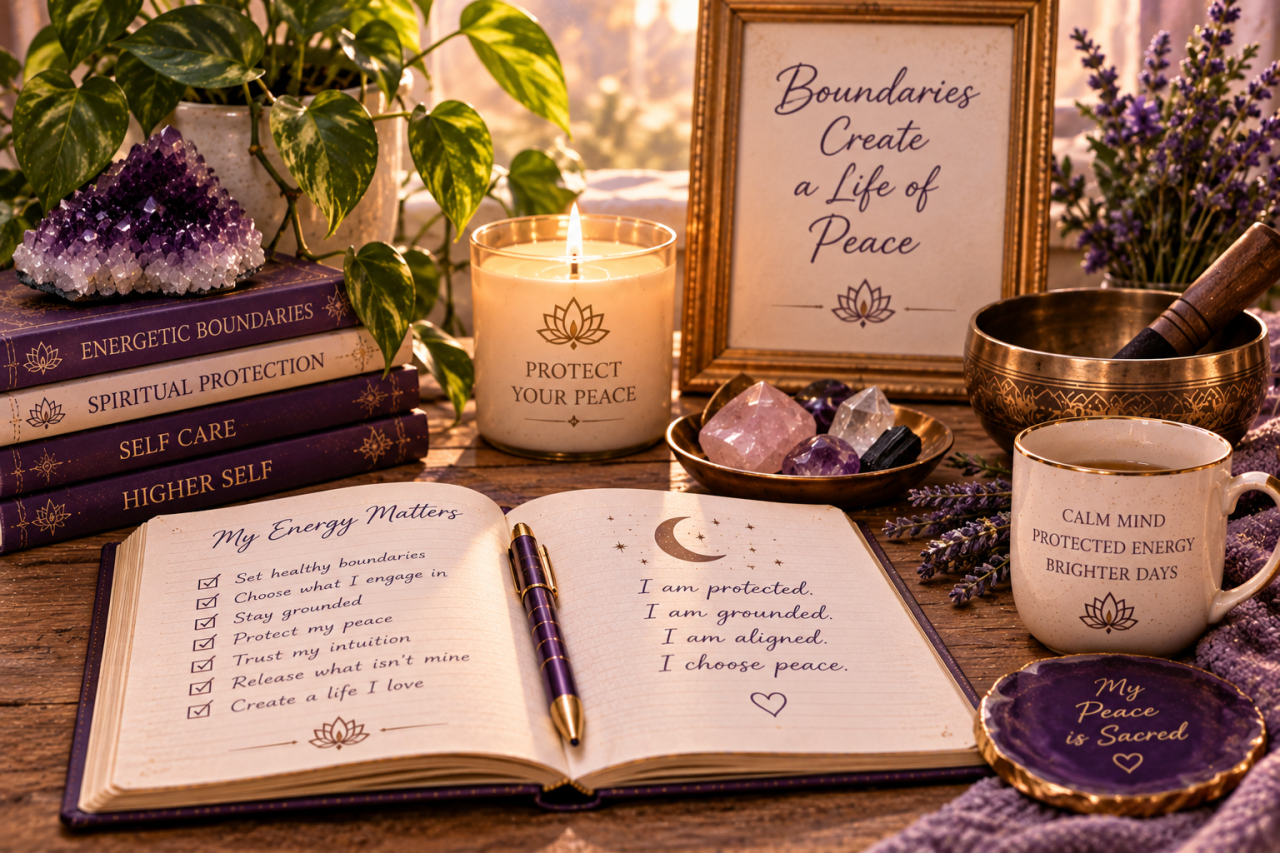
A Simple Daily Energy Protection Practice
Before you begin your day, place your hand over your heart and take three slow breaths.
Feel your feet connected to the earth.
Then say:
“I call my energy fully back to myself.
I release what does not belong to me.
I am rooted in my body, anchored in Divine Love, and surrounded by Divine Light.
I choose peace.
I choose discernment.
I choose where my energy flows.
My energy is my responsibility, and my boundaries are sacred.
I move through this day grounded, protected, guided, and sovereign.”
Then take one final breath.
And begin your day from that place.
You Don't Have to Give Everyone Access to You
One of the deepest lessons of spiritual empowerment is realizing that being loving does not mean being endlessly available.
Being compassionate doesn't mean tolerating disrespect.
Being intuitive doesn't mean absorbing everyone else's emotions.
And being spiritual doesn't require you to remain connected to people, conversations, environments, or online spaces that continually disrupt your peace.
You are allowed to protect what is sacred within you.
Sometimes spiritual protection is prayer.
Sometimes it's visualization.
Sometimes it's cleansing.
And sometimes the most powerful protection is simply saying:
No.
Not today.
I don't have the capacity.
I'm stepping away.
Your peace deserves your participation.
Ready to Strengthen Your Spiritual Boundaries?
If you're learning how to protect your energy without closing your heart, my Boundaries Toolkit can help you strengthen your boundaries, recognize where you're overgiving, and become more intentional about where your energy flows.
And if you're feeling energetically overwhelmed, spiritually disconnected, or struggling to understand what you're sensing around certain relationships or situations, you can also book a Private Intuitive Session with me for personalized support.
Related Posts
- How to Listen to Your Inner Voice 4 Ways to Strengthen Your Intuition
- 6 Powerful Ways to Become Spiritually Empowered and Step Into Your Highest Self
- The Truth About Spiritual Empowerment
- The Truth About Spiritual Empowerment The Good, The Challenges, and What No One Tells You
Disclaimer
This article is for educational, spiritual-development, and personal-reflection purposes. Concepts such as energy protection and energetic boundaries reflect spiritual and personal-development perspectives and should not be treated as medical or mental health diagnoses. If a relationship or situation is causing significant emotional distress, fear, abuse, or safety concerns, consider seeking appropriate support from a qualified professional.
Categories: : Spirituality